Friday, 17 February 2017


A nice morning for some hand mowing on the greens!!

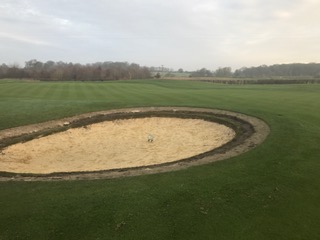
Also this week we have micro-cored the greens, applied liquid iron to the fairways and approaches and we have started to make some progress on the bunker renovation on the 6th green.


This bunker, once all the old sand had been removed, has had a soakaway installed, and lined with crushed chalk which we then compacted - to seal the chalk. We then applied a light dusting of sand so that if golfers went into the bunker to retrieve balls they wouldn't then leave white chalky footprints everywhere!
We then purposefully left the bunker to see how the chalk layer reacted through the winter- and thankfully it has performed very well. 
This week we have been building up the revetted face and backfilling so that next week we can turf the top and surround.


An update on the soil moisture levels..........!

Following the micro core and an application on penetrant, the moisture levels have dropped by 20%.

This clearly shows the importance of aeration and thatch removal... 

Friday, 10 February 2017


Throughout the year we will take many samples, readings and measurements of the greens in order to assess their condition.
These can be from visual tests- looking to see any obvious signs of change in the greens performance ie a change in turf colour, signs of disease occurrence. pest activity etc etc - to sending off  nutrient samples to assess how much nutrient has been retained in the rootzone.

Regularly we check the greens soil water content. During the summer we use this to assess our irrigation needs and during the winter to assess how the greens are draining.


We took these two readings from the 18th green 5 days apart. During the summer we will keep the greens at a moisture content of 15-25%. At 8% the surface will dry out (this is our 'wilt point'). During the 5 days of the readings we had very little rain so this shows how the thatch layer retains moisture and acts like a sponge making the surface soft and leading to a poorer surface with increased footprinting and open to increased disease incidence.

 This photo shows a soil profile sample from the 18th green taken from a high spot. The thatch layer is about 25mm thick.


 This photo, again from the 18th green, but from a low spot (where water accumulates) shows the thatch layer at about  60mm thick and notice the darker layering. This is where the soil is becoming anerobic, a condition called 'black layer'. 


This photo, again from the 18th, but taken from a level area shows the thatch layer at 40mm but you can also see the profile is lighter in colour and you can also see where we have recently cored and the sand infill present. Compared to the previous photo a much more healthier situation but still the need for thatch removal.


What these samples clearly present is how important thatch removal and topdressing is to the health of the plant and to the soil and how water content is also one of the controlling factors of how quickly organic matter (thatch) is decomposed in the soil. 

"The measurement of soil water content is a critical part  of good greenkeeping practice and groundsmanship. Monitoring soil water content can alert turf managers to potential problems before visual symptoms can become evident. It can also enable managers to assess the efficacy of turf maintenance operations."

Thursday, 17 March 2016

Update On 11th Bunkers


Sand has been delivered and the boys have been busy filling the new bunkers, 3 down just 2 more to go! Bunkers are still currently GUR, rakes have been placed in the bunkers for members and visitors to rake when retrieving their ball.


Signed Off Deputy Course Manager Joshua McCallum

Monday, 22 February 2016

Update On 11th Bunkers


Channel has been dug out for the rubber crumb shelf to be put in.


Ben and Tom mixing the rubber crumb and resin.


Me laying the rubber crumb shelf.


Rubber crumb shelf set and ready for revetted turf.


Pallet of revetted turf.


Ben backfilling sand behind the revetted turf.


Bunker prepped and ready for top turf.


 The far left green side bunker finished, now just needs sand adding. 


We have two more bunkers to revett, backfill and turf.


Signed Off Deputy Course Manager Joshua McCallum

Trip To John Deere Headquarters


We took the trip up to Nottingham to see the new release of there 9009A rough mower. We wanted to see for ourselves what all the hype was about and give it a inspection and test drive.  


The John Deere 9009A rough mower has a 2.7m cutting width and 55 hp engine with a new digital control display. Some of the new features it had on the control display were impressive, Password controlled for Course Managers preference, adjustable transport speeds, adjustable turning speeds and load match.    


Some of the fine turf machinery they had in stock.


Greens mowers.


Huge combine harvester on show. 


Some of the bigger tractors they had there.


Lots of compact tractors they had in stock.


Signed Off Deputy Course Manager Joshua McCallum

Monday, 1 February 2016

A Very Wet January!!!


We have had an exceptionally wet January, in total we have had 79mm of rainfall over Caversham Heath. As for yourself im sure you can see how wet the course is in places but i think we are coping rather well on greens and tees, some fairways are laying wetter than others. The verti draining has helped with draining standing water through the soil profile. Others things we have put in place to help with the wet conditions are, spreading sand over worn traffic areas and placing more post and rope around greens. We ask members and visitors with trolleys to keep to these marked areas to prevent play around the green becoming well-worn.

New Tee Distance Markers 26/1/2016

We started by taking the existing yard plates in, they had seen some wear and tear over the years. Alot of the concrete Tee stones had broken into parts making the Tee area look untidy and a hazard for our mowers. It was about time they needed changing!!!

After all the yard plates had been brought into the Greenstaff shed we took a wire brush to them to take off any scum and debris. Afterwards we gave them a hot jet wash so they came up looking like new.


 This rubber crumb is what we have used for the base of our new Tee stones, Its the same idea as the new bunkers that have been lined with rubber crumb on 4,7,9,and 11. The gluey resin which is set off by temperatures and moisture levels, within 2hrs it has already started to harden. After the rubber crumb has been poured into the already made sunken tee holes, I placed the refurbished Tee plates with some resin and set flush making sure no mowers would hit the Tee stones. 


This is the final product, I'm fairly happy with the final finish of the tee stones costing nothing in parts or material just man hours. hopefully they will last a while and making the overall tee area look a bit smarter. 


The Mapledurham wildlife has already been scraping and ripping up the rubber crumb, my guess would be the rabbits. So over the next few weeks we may be making some repairs to the Tee stones. 


Wednesday, 6 January 2016

Weather analysis

Some info on what the weather has brought us this year.


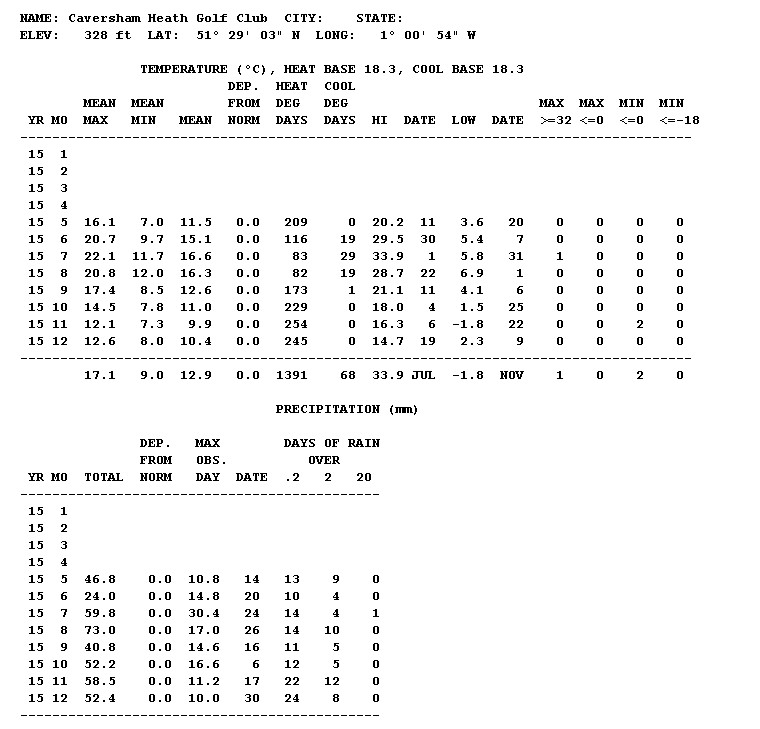
This chart shows a month's worth of temperatures and rainfall back from today. We have had a very warm December period, we had temperatures on Christmas day reaching 15 degrees hotter than Los Angeles. It has been a very wet start to the new year, we ask members to walk around roped off areas and stay off worn areas if possible.


This data started from May showing us the temperatures and rainfall there highs, lows and means. We had two very wet months July and August also with the summer sun causing a great deal of mowing this year throughout the summer. We had our hottest day on July the 29th reaching 33.9 degrees, Our lowest was on November the 6th reaching -1.8 degrees. The end of the year has been on average much higher around 12 degrees with increased rainfall, the normal is around 6 degrees.

What does this mean for Caversham Heath :

  • Grass is growing quicker.
  • More mowing is needed causing more traffic and wear on the course.
  • More golfers playing due to the warmer temperatures.
  • More roped off areas to manage traffic.

Some of the weather presents difficulties with our maintenance plans we will adapt and change plans as the weather switches.  

Tuesday, 8 December 2015


We would like to congratulate our apprentice, Tom Parker, on completing his Level 2 Diploma in Sportsturf.
Tom managed to complete this 18 month course in 11 months - a testimony to his hard work and determination both on and off the golf course. Well done Tom!!!

Monday, 30 November 2015

Verti Draining Fairways

Work has started on verti draining the fairways this may take a couple of weeks depending on weather and ground conditions. We ask members and guests to be patient with us at this time of year we may get in your way at times but will do our best to keep your golf round flowing. 


Fairways are generally aerated with tractor mounted aerators throughout the winter months (November-March) when the ground is moist enough to penetrate. Operating a deep tine with varying degrees of heave will prove beneficial for removing surface water and to maximise air movement through the soil.


  • Improves soil surface drainage.
  • Helps to increase soil temperatures.
  • increases soil pore space, allows gases exchanges in the soil (oxygen in carbon dioxide out) that improves root growth and development.
  • Aids integration of top dressings into the soil profile.
  • Aids breakdown of thatch/organic matter.
  • Promotes better surface levels that will increase ball roll/speed
  • Aids surface firmness/dryness thereby increasing ball bounce and surface grip.


The Tractor is moving at 1.5mph, tines depth at around 100mm and spacings of 70mm.

Tuesday, 17 November 2015

Soil Temperatures


The soil temperature in the greens is still at 10-11 celsius. Our average air temperature this month has been 11.7 celsius, fairly high for this time of year explaining the extended growth we are seeing. We are still cutting the greens 3 times a week and still harvesting a great deal of grass. Once the soil temperature drops to 5 celsius and below the grass will stop growing significantly.   


The soil temperature in the month of July when we are at our busiest. There's a dramatic difference in temperature from summer to winter really halting the grasses growth. I will record the soil temperature towards the end of December to compare the variation.  


A diagram to show  members and visitors the benefits of why we aerated the greens a few weeks back.  


Wednesday, 11 November 2015

Short Game Tee Now Open!!!


Range Renevation


The practice range tee has had a few more man hours put into it recently, having a new sign made up, a specific area for practice that will be moved daily, hand cut more regularly and a marked space for Head Pro Darren Bartlett to carry out his lessons. 


We ask that members and guests use the divot mix provided after using the practice facilities thanks.


One of our projects to be carried out over winter is to construct some greens range targets. If you have been up to the range you would have seen we've already made a start on marking the targets out and dumping some material. 

More to come on our progress on the range facilities.......


Tuesday, 13 October 2015

Volunteering At The British Masters


I started my week leaving from the Marquess sheds every morning at 5.30am. This was just some of the gear they had for the course there was plenty more back at the Dukes and Duchess sheds. We had torches to use in the mornings the first hour was pitch black, by 6.30 the sun was starting to come up and we could finally see the glory of the golf course. 


We were given specific tasks for the week planned out in our work schedule. I was on the crew that had the task of blowing tees and greens in the morning then moving onto final lap (making sure each hole was in check before the golf starting teeing off).


There were 10 John Deere mowers that cut the fairways green to tee just like the way they cut fairways at Augusta National. 


10 guys cutting the 18th fairway. 


Cutting the 7th fairway. 


Cutting the 7th fairway. 


As the morning went on people would drop onto final lap blowing and making sure we had everything in place. At some points we had up to 12 guys blowing on one hole. 


In the afternoons/evenings after the golf had gone through we would have crews divoting the fairways, blowing, smoothing bunkers and cutting tees.


Having a putt on the 8th. The greens were getting cut at 3mm.


Sky Sports TV studio.


Thought i deserved a pint in the sunshine after the first couple of days in. Watching golf from behind the 4th tee.


Ian poulter came up on the Wednesday before his practice round and whipped up a few sausage, bacon and egg baps.  


60-70 boxes of pizza. We were fed really well every day breakfast and lunch. Thanks for Woburn Golf Club for feeding us so well.  


Woburn Golf Club have a tradition of having a food eating competition each year. This year was a mighty burger!!! (3 beef burgers,chicken breast, bacon, hash brown and chips)


This is the new reservoir they have built this year its to the right hand side of the 15th tee and will supply all three courses.  


The grandstand on the first tee. We were watching the last groups tee off on the 3rd day.


7th


9th


7th my favorite hole, standing up the tv tower. 


Sun rising on 15th.


11th


Looking across the 3rd and 4th.


18th green at the beginning of the week.


7th

I really enjoyed my experience at Woburn Golf Club, volunteering for the British Masters. The week went by without a hitch from the greenkeepers. Ian poulter did an fantastic job bringing back the British Masters to Woburn Golf Club. Fitzpatrick, a young very deserved winner on this event for the race to Dubai. Just need to give a big thanks to the Woburn greenkeeping team for integrating us into the club and John Clarke for giving me the opportunity at such an impressive course.